
The Curated Void: Mr. Normal and the End of the Extraordinary
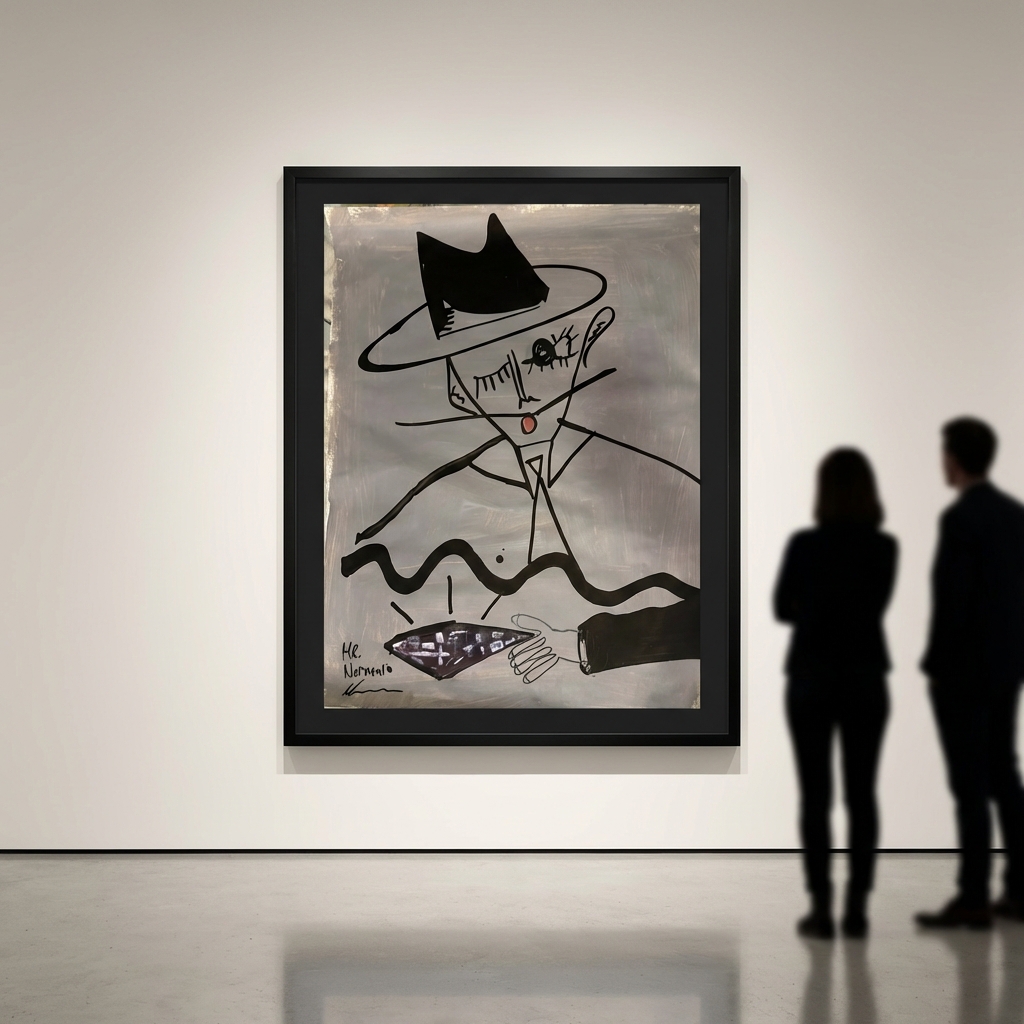
Mr. Normal Art – Stylized Magician Figure with Diamond – Contemporary Art 2026
The era of the spectacle is collapsing under its own weight. We have reached a point of saturation in the cultural centers of the world, from the neon-drenched humidity of Miami to the self-important concrete canyons of New York, where the pursuit of the “extraordinary” has become the most mundane activity of all. Everyone is a curator. Everyone is a brand. Everyone is shouting into the digital void, hoping for an echo that sounds like validation. It is within this cacophony of desperate uniqueness that we find the silent, terrifying comfort of the truly ordinary. We find Mr. Normal.
To understand the trajectory of Contemporary Art 2026, one must first dismantle the obsession with the new. We are witnessing the birth of Neo-Normalism, a movement that does not seek to shock you with novelty, but rather to disturb you with familiarity. The art world has spent the last decade fetishizing the complex, the algorithmic, and the hyper-political. In response, Mr normal offers a flat, monochromatic reflection of our own exhaustion. It is a pivot away from the screaming headlines and toward the quiet hum of the refrigerator. It is the realization that the most radical act one can commit today is to simply exist without fanfare.
Let us consider the visual evidence presented in the gallery space, a sanctuary of silence amidst the noise. The work in question captures the essence of this philosophy with brutal elegance. We see a figure, sketch-like and raw, rendered in broad, confident strokes that defy the polished perfection of the digital age. This is Post-AI Realism in its purest form. While artificial intelligence strives to render the perfect hand or the flawless complexion, Mr. Normal revels in the beautiful incompetence of the human gesture. The figure wears a hat, a fedora of sorts, perched with a jaunty angle that suggests a performance is about to begin. But what is the performance?
The subject appears to be a magician, or perhaps a carnival barker, holding a diamond shape in an outstretched hand. But look closer at the diamond. It is not a gleaming jewel of photorealistic quality. It is a rough geometric abstraction, a symbol of value rather than value itself. The figure winks—or perhaps the eye is simply missing, erased by the apathy of the artist—suggesting that the magic trick is a fraud. The trick is that we believe there is something special to see. The lips are a smear of red, a clownish accent in a sea of grey and black, hinting at the forced smile of modern social interaction. This is Satirical Pop Art stripped of its candy coating. It is Warhol without the soup; it is the can, empty and crushed.
The viewers in the gallery stand before it, silhouetted against the stark white wall. They are the participants in this grand joke. They look for meaning in the scribbles of Mr Normal, projecting their own desires for profundity onto a canvas that promises nothing. This interaction is the art. The painting is merely the catalyst. Unlike the street-level theatrics of Banksy, which rely on the location for context, or the mass-produced vinyl collectibles of Kaws, which rely on the commodity fetish, Mr. Normal relies on the tension between the viewer’s expectation and the artwork’s refusal to perform.
We must ask ourselves where this leaves the collector in the landscape of Modern Gallery Culture. The traditional metrics of value—scarcity, technical virtuosity, historical narrative—are being rewritten. If you are navigating this shift and find yourself confused, you might feel compelled to ask the question: /who-is-mr-normal? But to ask is to miss the point. Mr. Normal is not a person to be biographed; he is a mirror to be looked into. He is the aggregate of every average day you have ever lived, distilled into an aesthetic experience.
The critique embedded in this work extends beyond the canvas and into the very infrastructure of the art market. In a world where digital assets and NFTs promised a revolution but delivered a speculative bubble, the tactile reality of paint on canvas returns with a vengeance. However, this is not a return to the Old Masters. It is a return to the primal mark-making of the bored human. It is the doodle on the notepad during a meeting that could have been an email. It is the graffiti in the bathroom stall that says nothing political, just “I was here.”
Mr normal occupies the space between the digital and the physical, a realm we might call Post-Digital Minimalism. The work acknowledges the internet culture—the speed, the disposability, the memes—but translates it back into slow, static media. The “diamond” in the painting is a glitched icon, a low-resolution promise of wealth. The figure is an avatar that forgot to load completely. By freezing these fleeting digital anxieties in paint, the artist forces us to confront them not as scrolling content, but as permanent fixtures of our reality.
As we look toward the future of Contemporary Art 2026, the influence of this approach becomes undeniable. The excess of the past decade is being trimmed away. The “extraordinary” has become a burden. We are tired of being amazed. We crave the stability of the normal. Mr. Normal understands this fatigue better than anyone. He does not ask you to change the world. He does not ask you to be a revolutionary. He asks you to look at a crudely drawn man in a hat holding a fake diamond and acknowledge that this is enough.
The establishment will try to categorize this. They will call it “outsider art” or “neo-expressionism.” They will try to invite Mr Normal to the biennials and the galas. But the work resists easy classification because it refuses to play the game of intellectual one-upmanship. It is aggressively simple. It is the anti-thesis to the thesis of the art school graduate. It is the visual equivalent of a shrug.
In the end, the power of this specific piece lies in its honesty. The magician has no rabbit. The diamond is just paint. The winking eye sees through the pretension of the gallery space. If you find yourself drawn to this void, if you find comfort in the lack of spectacle, then you are already part of the movement. You are ready to embrace the state of normalcy. You are ready to stop striving and start seeing. To explore the full breadth of this philosophy and the collection that defines it, you must return to the source. Enter the world of the extraordinary ordinary at /. There, you will find that the only thing left to discover is the profound beauty of absolutely nothing happening.